

Terra’s collapse remains a reference point for structural failure in crypto. Capital vanished, supply expanded at scale, and aggregate valuation constraints replaced narrative confidence. Since then, Terra Classic (LUNC) has traded as one of the market’s most debated recovery assets. The $1 target persists, but it raises a harder question: Does the supply equation even allow it within a realistic timeframe? That depends on burn velocity, circulating supply reduction, exchange depth, and macro capital cycles.
What Is Terra Classic (LUNC)?
Terra Classic is the original Terra blockchain that remained after the 2022 chain split. Before the separation, the network focused on decentralized payments built around an algorithmic stablecoin model. That model centered on TerraClassicUSD (USTC), previously known as UST, which aimed to maintain a $1 value through an on-chain supply mechanism. LUNA was the original native token used in that structure. When demand for USTC increased, LUNA was burned. When demand fell, LUNA supply expanded. The design functioned during growth phases, but once confidence declined, supply growth accelerated, and price support weakened. After the split, a new Terra 2.0 launched with a separate LUNA token, while the original chain continued as Terra Classic and its token became LUNC.
History and Market Behavior

ALT: Shattered Terra logo symbol on a blue background
Terra moved from dominance to collapse within months. Its expansion phase reflected structural leverage inside an algorithmic stablecoin system, and the unwind exposed the fragility of that design. At its peak, Terra’s DeFi total value locked reached roughly $21.7 billion in May 2022, representing nearly 15% of total DeFi market share at the time. That scale amplified both confidence and systemic exposure. Once UST lost stability, redemptions triggered aggressive supply growth. As a result, LUNA supply increased from roughly 350 million to more than 6.5 trillion units within days during the defense attempt. At the same time, approximately $60 billion in market value was erased in May 2022. The original chain continued as Terra Classic, but its pricing structure had changed. Subsequent rebounds were largely speculative, usually tied to burn headlines or broader altcoin participation cycles. Price stability depended less on utility and more on capital rotation and exchange depth.
These events permanently altered LUNC’s structure. Here are the lasting consequences:
- Supply expanded dramatically.
- Market capitalization constraints became dominant.
- Price reaction became tied to broader market cycles.
Why the $1 Target Is Structurally Difficult
The $1 case starts with basic math. LUNC’s token count remains measured in trillions, which means every dollar of price translates into an enormous total valuation. At $1, the network would sit in multi-trillion territory. That level stands far above the peak valuation reached by most digital assets in previous cycles. Then consider burn velocity. Even steady reductions remove only a small share of total supply unless sustained for many years. Without meaningful contraction, price expansion depends largely on fresh capital entering the market rather than reduced token count. And capital at that scale requires broad market growth and deep exchange participation.
Terra Classic Price Prediction for 2026
The 2026 forecast reflects broader crypto conditions and participation levels. According to projections from CoinCodex, these are the expected price ranges throughout the year.
Q1–Q2 2026 (January-June)
Terra Classic is projected to begin 2026 with an average price of $0.00002586 in February and $0.00002869 in March. Maximum estimates during this period reach $0.00003848. In April, the average rises to $0.00003267 before easing slightly in May to $0.00003212. June shows the strongest average of the first half at $0.00003821, with a projected high near $0.00003957. If participation remains steady, the price is likely to trade within this defined band.
Q3–Q4 2026 (July-December)
From July through September, average prices range between $0.00002937 and $0.00003188. By October, the average falls to $0.00002839. November and December show further decline, with December averaging $0.00002430. A stronger move higher would require acceptance above the $0.000039–$0.000040 range. Confirmation would need higher trading volume sustained over multiple sessions. Without that participation, the price is likely to remain within established levels rather than move into a higher range.
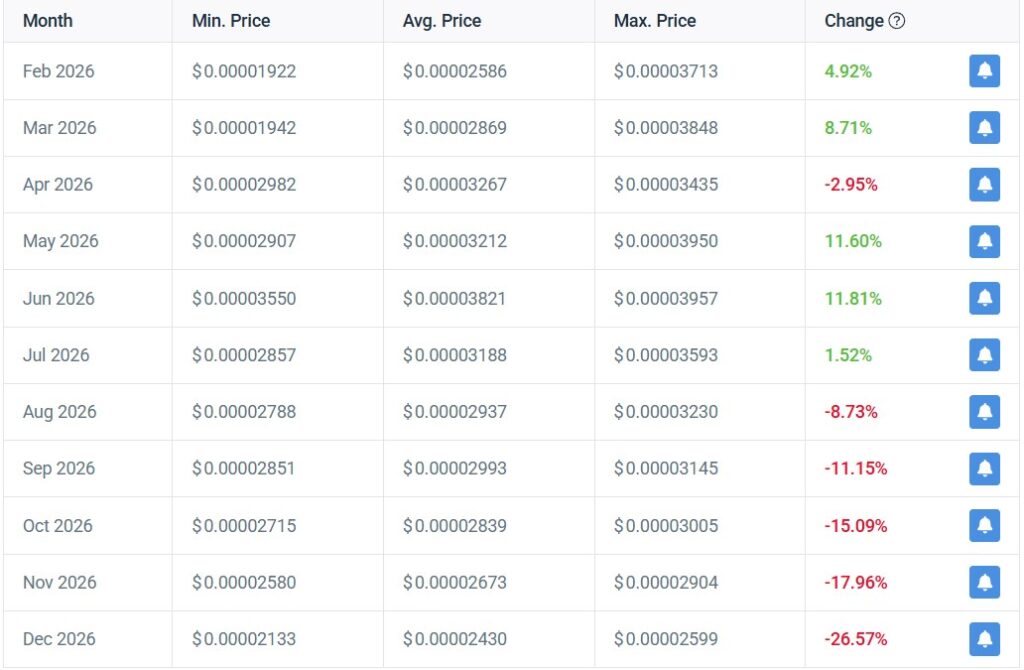
ALT: CoinCodex 2026 Terra Classic monthly price forecast table from the chart
Technical Outlook and Key Levels (2026)
Price remains inside a defined range. Buyers step in near lower levels, while sellers appear as the price approaches resistance. Volume has cooled compared with prior spikes. That suggests controlled participation rather than aggressive positioning.
With that in mind, these are the key levels to monitor:
Key Support Levels
- $0.0000314
- $0.0000390
Key Resistance Levels
- $0.0000364–$0.0000385
- $0.0000430–$0.0000436
Terra Classic Price Prediction for 2027
The 2027 estimates suggest a year that starts weak and then attempts recovery. Based on CoinCodex data, these are the two main directions the year could take.
Expansion Scenario
January through March show average prices between $0.00002008 and $0.00002134. This range stays below mid-2026 levels. From May through July, projected averages rise toward $0.00003466 in June and $0.00003576 in July, with highs near $0.00003943. For this move to continue, broader altcoin participation must increase. Burn reductions would need to remove a visible share of the total supply over time. Exchange activity would also need to support steady buying pressure so the price can remain above the $0.000034–$0.000036 area.
Containment Scenario
If capital flows into other sectors, averages may return to the $0.000025–$0.000027 range seen in November and December. Burn activity that remains small compared with the total supply would limit repricing potential. In that case, the price would trade within a tighter band.
To clarify what would support stronger performance, these are the drivers:
- Consistent burn transparency
- Higher exchange volume
- Stronger macro risk appetite
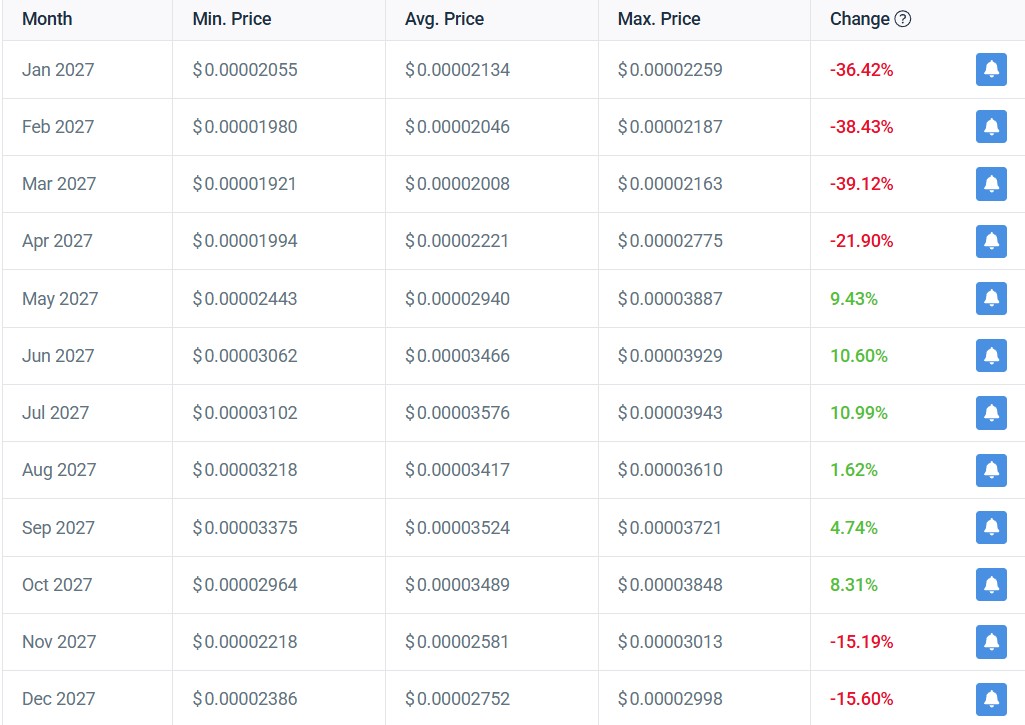
ALT: CoinCodex 2027 Terra Classic monthly price forecast table from the chart
Terra Classic Price Prediction for 2030
By 2030, the discussion moves from short-term cycles to structural survival. According to CoinCodex estimates, average prices in 2030 range between $0.00001346 in February and $0.00001793 in December, with projected highs near $0.00002048 in March and $0.00001961 in December. These levels remain far below prior cycle peaks, which highlights the weight of supply.
Terra Classic must retain exchange support across major venues. At the same time, cumulative burns would need to remove a meaningful share of total supply over multiple years. And the global crypto market scale by 2030 would need to expand enough to support higher aggregate valuations.
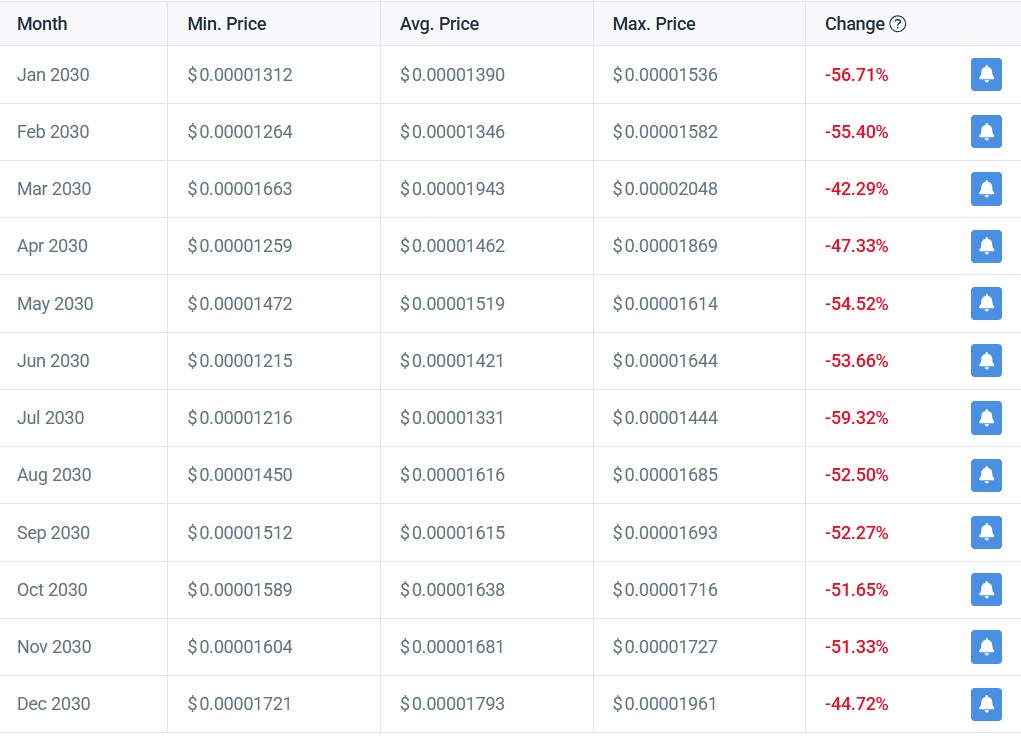
ALT: CoinCodex 2030 Terra Classic monthly price forecast table from the chart
Terra Classic Price Prediction for 2040
According to CoinCodex projections, average prices range from about $0.00004497 in April to $0.00005461 in December, with projected highs near $0.00005570. These figures show gradual appreciation over time, yet they remain far from extreme valuation targets. That gap reinforces how supply scale continues to weigh on long-term assumptions. Long-range outcomes depend first on whether Terra Classic remains actively traded across major exchanges. If it persists, appreciation would still tie back to measurable supply reduction and the overall size of the global digital asset market. Without those conditions, the price would remain primarily speculative.
For LUNC to remain relevant in 2040:
- Continued exchange access
- Active governance participation
- Significant cumulative supply reduction
- Broad digital asset adoption worldwide
Each of these variables carries structural weight. Exchange access supports participation depth. Governance activity sustains development. Supply reduction changes the capital equation. And global market expansion provides the capital base required for higher aggregate pricing.
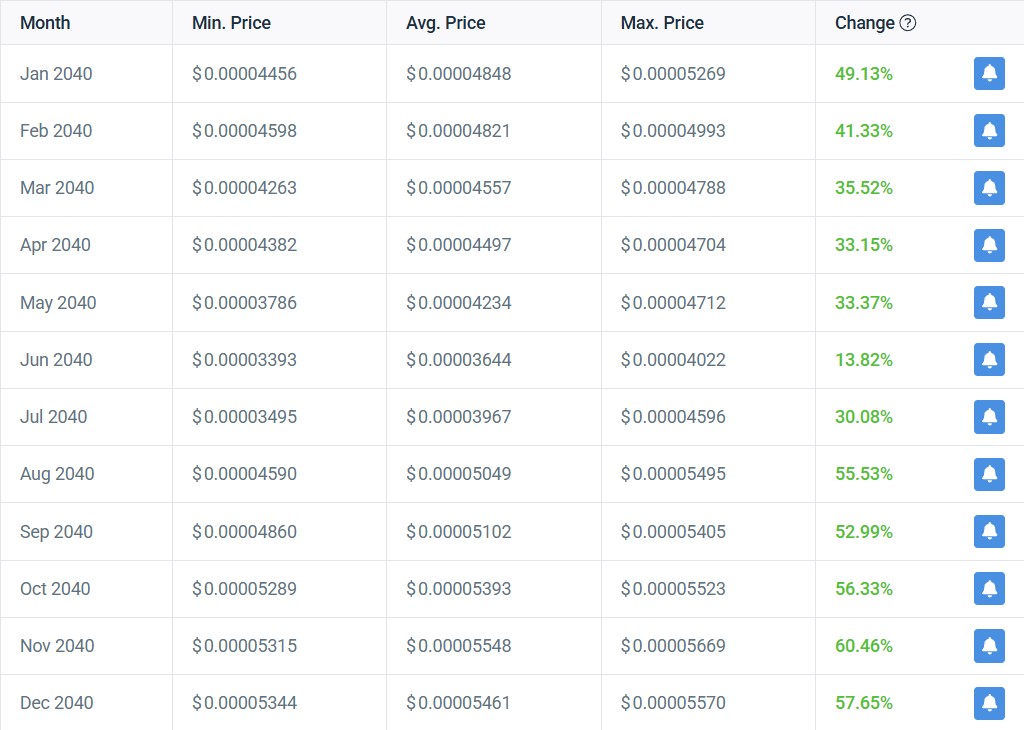
ALT: CoinCodex 2040 Terra Classic monthly price forecast table from the chart
Key Drivers That Could Push LUNC Higher
Any sustained appreciation must come from structural improvement rather than temporary price spikes.
These are the primary variables that could support higher levels over time:
- Accelerated burn progress
- Stronger exchange volume
- Broad altcoin expansion phase
- On-chain usage recovery
- Governance stability
- Favorable macro risk environment
Accelerated burns matter only if they remove a meaningful share of total supply over multiple years. Stronger exchange volume supports deeper participation and reduces price sensitivity to isolated trades. A broad altcoin expansion phase can lift high-beta assets, but cycle-driven gains differ from structural repricing. On-chain usage recovery and governance stability help maintain network relevance, which supports continued exchange listing. Still, supply size remains the central constraint. Without measurable contraction relative to trillions of tokens, long-term upside will depend more on capital scale than on narrative strength.
Risks That Could Limit LUNC’s Upside
These are the primary risks that could limit long-term appreciation:
- Large supply overhang
- Weak exchange activity
- Delistings
- Regulatory pressure
- Governance disputes
- Capital rotation into newer narratives
A large token count keeps capital requirements elevated. Even moderate price increases require significant aggregate capital. Weak exchange activity reduces depth, which increases price sensitivity and limits sustained expansion. Delistings would directly restrict access and reduce participation. Regulatory pressure can narrow investor access across regions. Governance disputes may slow burn implementation or weaken coordination. Capital rotation into newer ecosystems remains another persistent risk. When attention and funds move elsewhere, recovery assets struggle to attract sustained participation. Ultimately, each of these risks ties back to supply scale and capital requirements. Without consistent demand relative to total supply, long-term price expansion becomes structurally difficult.
Conclusion
The $1 debate is about scale. With trillions of tokens outstanding, price appreciation must be evaluated against total valuation, burn pace, and the amount of capital required to support higher levels. Across 2026, 2027, 2030, and 2040, the structure remains consistent. Burn activity must remove a meaningful share of supply over time. Exchange access must remain intact to support participation, and the broader crypto market must expand enough to justify higher aggregate valuations. So the real question is survivability first, appreciation second. Short-term advances can occur during strong altcoin periods. Yet durable repricing depends on measurable contraction and sustained capital depth. Until those variables change, $1 remains a low-probability structural outcome rather than a baseline expectation.
For more crypto market analysis, visit CoinWicks.
Frequently Asked Questions (FAQ)
1. Can Terra Classic (LUNC) reach $1?
At $1, LUNC would require a multi-trillion valuation due to its large supply. That would demand extreme long-term supply reduction and massive global capital inflow. As it stands, this remains a low-probability scenario.
2. What could LUNC be worth in 2026?
Current projections place 2026 mostly between $0.00002 and $0.00004. Higher levels would depend on broader market strength and steady burn progress.
3. What is a realistic outlook for LUNC by 2030?
By 2030, survival and cumulative supply reduction matter most. If exchange access remains stable and burns reduce supply meaningfully, moderate gains are possible.
4. What factors matter most for Terra Classic’s price?
Supply size, burn consistency, exchange participation, and overall crypto market conditions drive long-term valuation.