

Turbo began as an AI-generated meme experiment. Its origin drew attention quickly, but attention alone does little for valuation stability. The core issue is structural valuation and the capital scale required to support it relative to circulating supply. Exchange depth must also sustain consistent participation across expansion and contraction phases. Short periods of speculation can lift prices sharply. Over longer horizons, valuation depends on recurring demand that absorbs available supply. That requires clear market cap math, realistic assessment of concentration risk, and evidence of listing stability across cycles. This analysis focuses on structural conditions and capital mechanics instead of headline targets.
What Is Turbo Coin?
Turbo Coin (TURBO) launched in 2023 and was created through prompts given to a language model with a limited starting budget. That origin created immediate narrative traction. However, narrative traction alone does little for long-term valuation stability. Technically, Turbo operates as an ERC-20 token on Ethereum. It carries limited functional utility and primarily serves as a tradable asset within the meme sector. As a result, demand is largely driven by market participation instead of on-chain usage. Today, Turbo occupies a position between meme culture and AI-branded digital assets. Listings on major centralized exchanges provide access, but order book depth varies across platforms. Resilience during both rallies and pullbacks remains central when evaluating capital commitment beyond short-term rotation.
Turbo Coin Price History
Turbo entered the market during a period of strong meme-sector participation. Early exchange listings provided access to broader capital, which supported its initial breakout. As capital rotated into high-beta assets, Turbo experienced rapid appreciation driven primarily by speculative allocation. At its peak phase, daily volume moved into the $10–$20 million range during high participation periods. That expansion in turnover coincided with its all-time high on December 11, 2024, near $0.0144.
However, retracement followed as meme allocation cooled. Current pricing around $0.0011-$0.0020 places the token roughly 90% below its peak, with market capitalization fluctuating between $70 million and $120 million. This compression highlights sensitivity to broader altcoin cycles. During consolidation phases, volume contracts meaningfully, which underscores how price behavior depends on sustained capital participation.
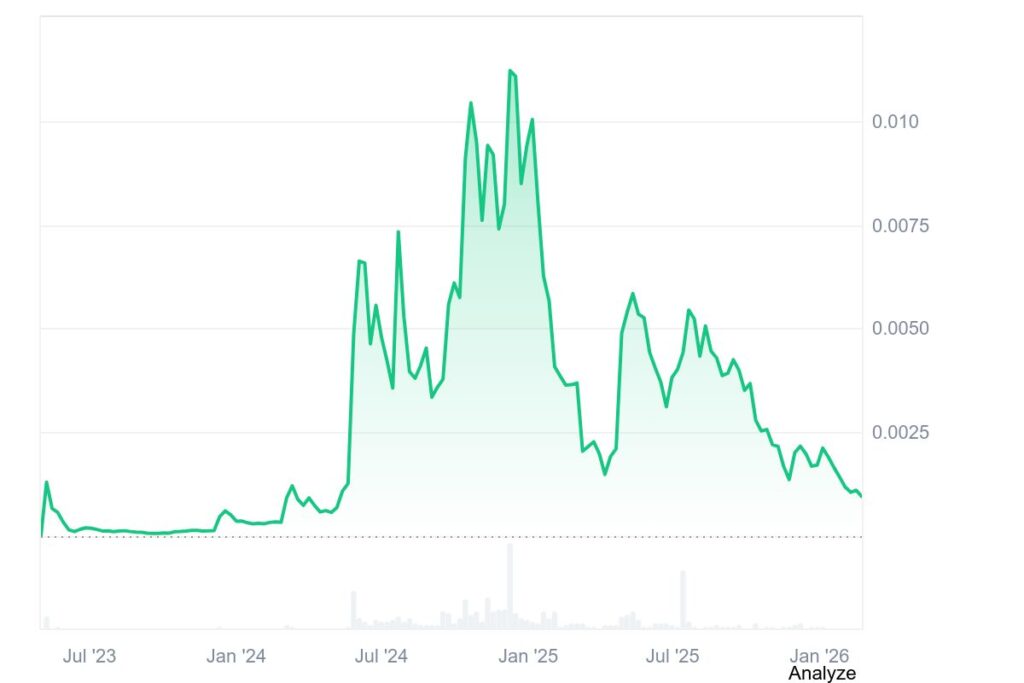
ALT: Turbo price chart showing a sharp peak and retracement
Turbo Coin Price Prediction for 2026
The early part of 2026 will test whether capital allocation returns to the meme segment with enough depth to sustain higher pricing. The following scenarios reflect structural participation trends and reference projections from CoinCodex.
Q1-Q2 2026 (January-June)
In the first half, CoinCodex projections suggest a broad range environment, which aligns with recent compression on the chart. A range of $0.0010–$0.0030 reflects prior reaction zones. For upside continuation, daily turnover must expand beyond recent averages as price approaches the $0.0025–$0.0030 resistance area. Repeated closes above that band would signal active absorption of supply. Without consistent order book depth, attempts to reclaim higher levels may stall near prior distribution zones.
Q3-Q4 2026 (July-December)
The second half presents two paths. One involves consolidation between $0.0012–$0.0025 as participation stabilizes. The alternative requires a decisive break above $0.0030, supported by steady capital inflow across meme assets. To evaluate confirmation strength, these are the signals that matter:
- Sustained volume expansion across multiple sessions
- Formation of higher lows on the daily structure
- Clean break and hold above major resistance near $0.0030
Each reflects a capital commitment that extends beyond brief speculative rotation.
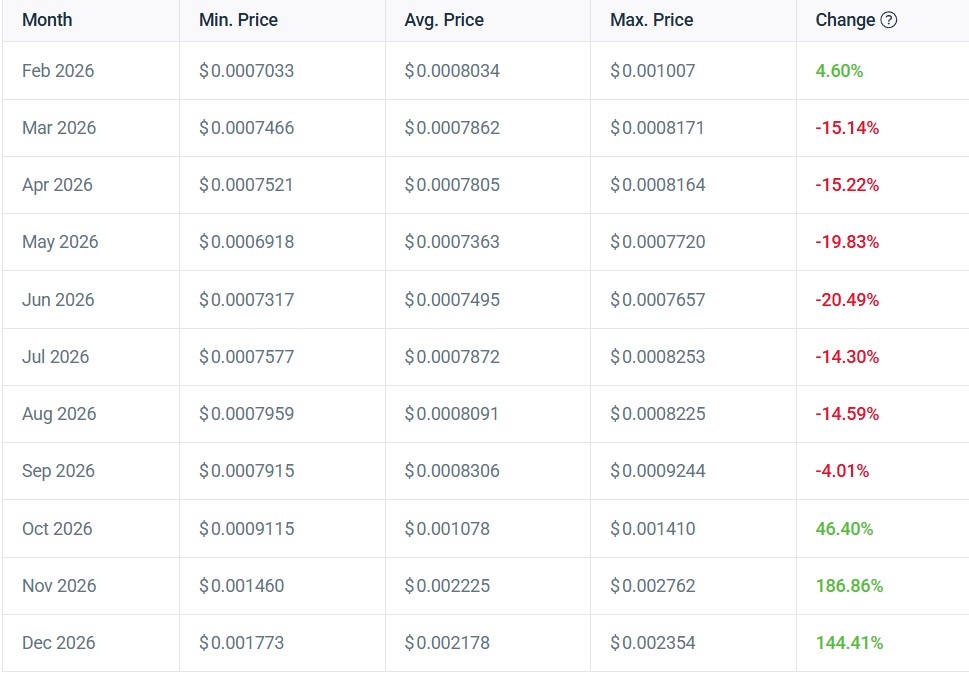
ALT: Turbo 2026 monthly price forecast table
Turbo Coin Price Prediction for 2030
By 2030, the analysis centers on structural persistence across multiple market phases. Meme tokens that last through repeated expansion and contraction cycles usually convert community attention into steady exchange depth and recurring capital engagement. Without that transition, valuation tends to compress after each cycle peak.
Structural Expansion Scenario
Under a constructive framework, several conditions would need to align.
- First, total crypto market capitalization would need to grow materially, which increases the capital base available for higher-beta assets.
- Second, the meme sector would need broader acceptance within major exchange ecosystems.
- Third, Turbo would require wider exchange exposure with consistent turnover across venues.
Finally, community engagement must translate into repeat demand instead of episodic spikes. In that environment, a projected band such as $0.003-$0.006 could be defensible if the circulating supply remains stable and market capitalization scales in line with prior meme leaders.
Contained Scenario
If capital rotates into infrastructure assets or meme participation contracts, the price could remain closer to a $0.001-$0.002 band. Reduced turnover and thinner order books would limit upside. In that setting, valuation stays range-bound and closely tied to broader altcoin cycles.
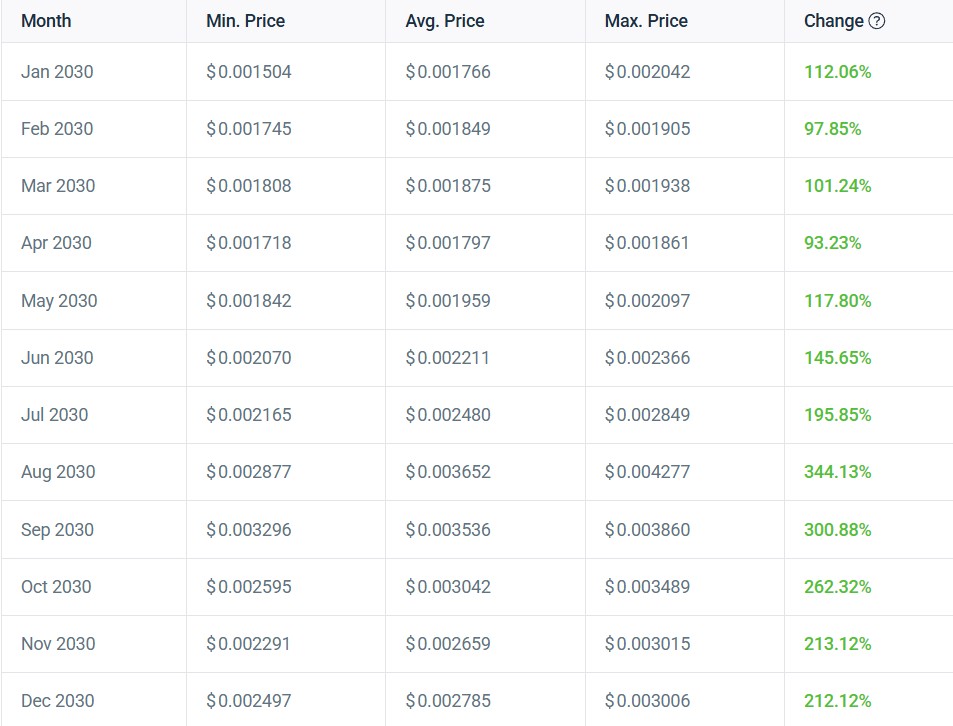
ALT: Turbo 2030 monthly price forecast table
Turbo Coin Price Prediction for 2040
By 2040, the central issue is survival across multiple market eras. Monthly projections from CoinCodex indicate averages between roughly $0.0040 and $0.0068 during the year, with upper bounds near $0.0072. Those figures imply meaningful appreciation from current levels. However, price alone carries little weight without a durable exchange structure and consistent order book depth.
First, exchange retention becomes critical. If Turbo remains listed across major venues with consistent order book depth, access to global capital remains intact.
Second, meme culture would need to mature into lasting digital brand equity. Temporary attention cycles would not sustain valuation for more than a brief period.
Third, the total crypto market capitalization must expand substantially. A multi-trillion aggregate market provides the capital base required to justify higher per-token pricing without distorting market cap ratios.
At a projected band near $0.005-$0.007, market capitalization would need to scale proportionally with circulating supply. That requires broad participation across cycles. Long-range projections depend far more on global capital expansion than short-term narrative spikes.
For Turbo to remain relevant by 2040, these are the conditions that matter:
- Continued exchange access
- Active community governance
- Deep trading liquidity
- Broad digital asset adoption
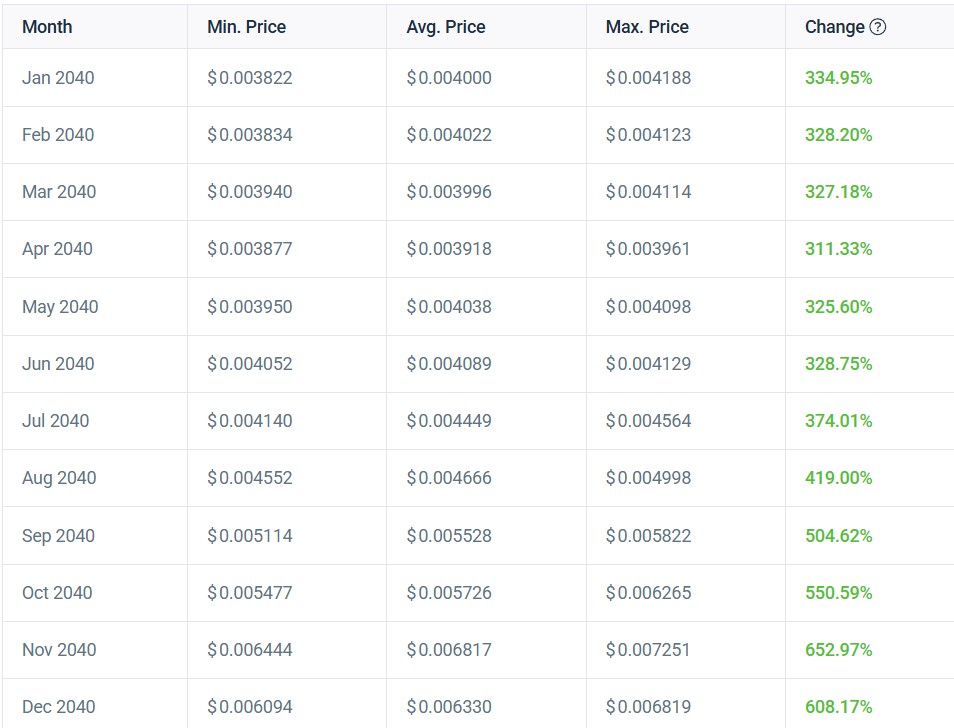
ALT: Turbo 2040 monthly price forecast table
Could Turbo Coin Reach $1?
Turbo’s circulating supply sits in the tens of billions of tokens. At $1 per token, the total market capitalization would move into the tens of billions of dollars. That figure places Turbo in the same valuation tier previously occupied by leading meme assets at peak expansion phases. For context, only a small number of meme tokens have sustained multi-billion dollar capitalizations, and those occurred during periods of extreme market-wide capital inflow. A $1 price would require comparable or greater aggregate participation. So mathematically, the target remains possible. Structurally, however, it demands global crypto expansion, deep exchange participation, and sustained capital allocation across cycles. Without that scale, the probability remains limited.
Key Drivers That Could Push Turbo Higher
Price expansion requires identifiable structural support. These are the primary drivers that would need to align for sustained upside.
- Sustained exchange listings
- Broader meme token participation
- Increased trading volume consistency
- Integration into AI or community-driven ecosystems
Each factor influences capital durability. Continued listings preserve global access. Wider meme participation increases allocation pools. Consistent turnover strengthens order book depth. Integration beyond pure speculation can extend holding periods and reduce reflexive sell pressure.
Beyond internal factors, broader market conditions also matter.
These are the macro drivers to consider:
- Bitcoin-led expansion cycle
- Retail capital re-entry
- Global risk-on environment
When aggregate crypto capitalization expands, higher-beta assets typically receive proportional inflows. Without that backdrop, structural upside remains constrained.
Risks That Could Limit Turbo’s Upside
Sustained valuation requires durable capital participation across cycles. When structural support weakens, compression follows. These are the primary risks to monitor:
- Meme sector participation decline: Reduces capital allocation to meme assets, which weakens demand during expansion attempts and limits follow-through above resistance zones.
- Exchange delistings: Restrict global access and narrow the available capital base, directly affecting order book stability and long-term listing retention probability.
- Thin liquidity: Increases slippage and price sensitivity to large orders, making sustained advances difficult during both rallies and pullbacks.
- Whale concentration: Concentrated supply introduces overhang risk, especially during volatility spikes when large holders can influence short-term structure.
- Regulatory pressure: Constrains exchange exposure and regional participation, reducing aggregate capital depth.
- Capital rotation into infrastructure tokens: Redirects allocation toward utility-driven assets, leaving meme valuations with reduced structural support.
Conclusion
Turbo’s long-term performance depends less on short-term volatility and more on structural endurance. Price swings can occur during speculative phases. Over time, valuation rests on supply math and sustained market depth. Circulating supply defines the market cap threshold, and that threshold requires proportional capital support. In 2026, the focus centers on rotation dynamics and turnover strength. By 2030, persistence across multiple cycles becomes critical. Looking toward 2040, exchange retention and broad capital expansion determine viability. Each year introduces higher structural requirements.
For continued analysis grounded in capital mechanics, visit Coin Wicks.
Frequently Asked Questions (FAQ)
1. Can Turbo Coin reach $1?
At $1, Turbo’s market capitalization would move into the tens of billions based on current circulating supply. That level requires capital participation comparable to peak meme leaders. Mathematically possible, but structurally dependent on large-scale global crypto expansion and sustained exchange depth.
2. What could Turbo Coin be worth in 2026?
In 2026, price is likely to trade within a defined range shaped by altcoin participation and order book strength. A band between $0.001 and $0.003 remains possible if turnover expands. Without broader capital rotation, valuation may stay compressed.
3. What is a realistic outlook for Turbo by 2030?
By 2030, the key variable is persistence across cycles. If exchange listings remain intact and meme participation retains capital support, moderate appreciation is feasible. Without structural continuity, valuation tends to revert toward lower bands.
4. What factors matter most for Turbo’s price?
Circulating supply sets market cap thresholds. Exchange depth determines capital access. Trading activity influences price stability. Broader crypto conditions dictate aggregate allocation. Together, these variables define structural probability across cycles.