
Learn what drives Onyxcoin price prediction for 2026, 2027, 2030, and 2040, with structural analysis, risk factors, and market-driven scenarios.
Onyxcoin’s past left a clear mark on its valuation. After a strong rise, the asset faced sustained pressure that forced both price and positioning to change.
Earlier gains reflected broad investor inflows and speculative rotation into mid-cap tokens. Since then, tighter capital conditions and supply changes have altered the demand equation. If allocation rotates back into higher-beta infrastructure tokens, price compression may ease. The next phase depends on whether consistent token demand can absorb the circulating supply.
What Is Onyxcoin (XCN)?
Onyxcoin (XCN) is the governance and utility token of the Onyx Protocol, a blockchain infrastructure project that began as Chain Protocol.
The network launched in 2022 and later rebranded to Onyxcoin as development progressed and token mechanics were refined. XCN is used for governance voting, staking mechanisms, and network operations. That structure ties token demand directly to protocol participation. With a large maximum supply, sustained network usage is critical to long-term price stability.
Onyxcoin Price History & Market Reset
Price history clarifies how the current valuation developed. Two distinct phases stand out.
Early Expansion and Peak Cycle
Onyxcoin became tradable in 2022 after its transition from Chain Protocol and gained exchange listings that expanded market access. Circulating supply stands near 37 billion tokens out of a maximum of 68.9 billion. More than half of the total supply is therefore already in circulation. During the 2022 expansion, XCN reached an all-time high of about $0.1841. That peak reflected aggressive speculative inflows and broad rotation into mid-cap infrastructure tokens.
Multi-Year Drawdown and Restructuring
Onyxcoin currently trades about 97% below its peak, and remains near $0.005. Daily trading volume still records several million dollars, which shows continued though reduced participation. This compression positions Onyxcoin as a reset-phase asset trading at a fraction of its prior peak.
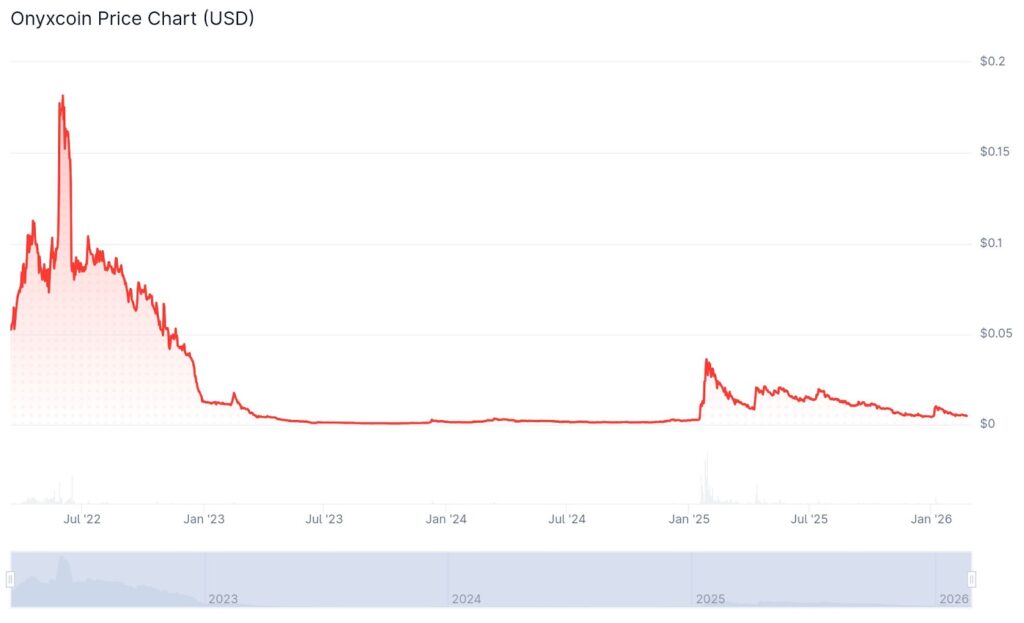
ALT: Onyxcoin (XCN) price chart showing all-time decline and volatility
Onyxcoin Price Prediction for 2026
CoinCodex forecasts indicate a narrow trading band, with upside dependent on renewed participation in mid-cap tokens.
Q1 2026 (January – March)
The year likely begins with XCN remaining near its existing levels, with minimum prices around $0.0051 and average values near $0.0053 reported by multiple forecast models. Maximum prices may push toward roughly $0.0055 if intra-quarter momentum expands, but any break above that level would require notable increases in exchange activity and order flow.
Q2 2026 (April – June)
Minimum prices across models remain near $0.0051, with average forecasts just above that level. Maximum outcomes depend on improved market depth and rotation into infrastructure tokens. Without measurable expansion in volume and order book depth, resistance near current highs is likely to hold.
Q3 2026 (July – September)
Minimum projections stay near $0.00505, while the average is near $0.0053. Speculative expansion is unlikely absent sustained volume growth.
Q4 2026 (October – December)
By the end of 2026, forecasts suggest capped upside under normal conditions. Models place maximum prices near the mid-$0.005 range, with average values aligning closely to earlier quarters. For higher ranges to materialize, XCN would need a clearer breakout above long-standing resistance, coupled with renewed interest in mid-cap infrastructure assets.
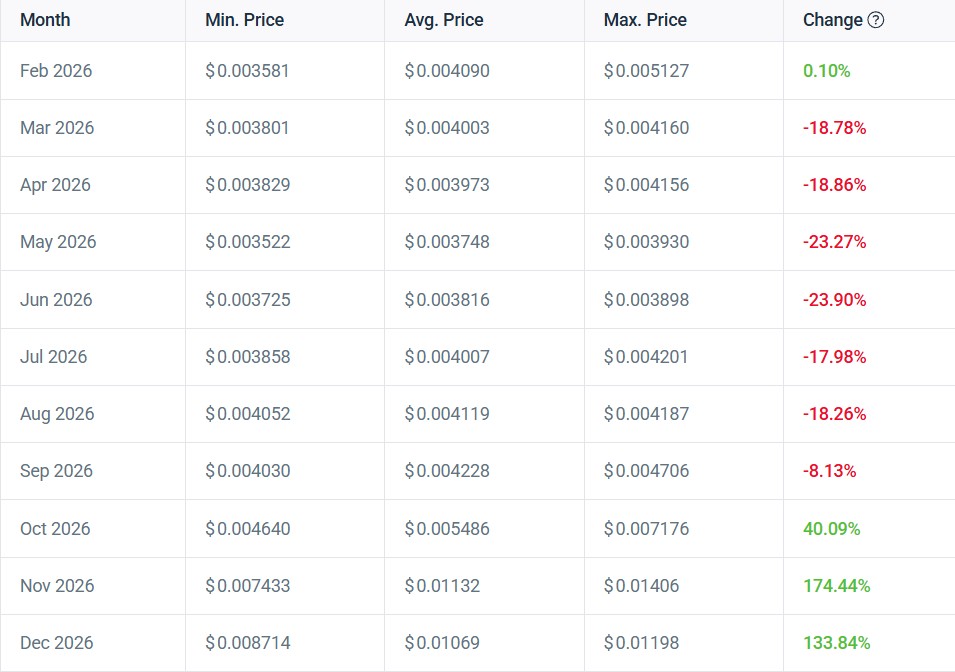
ALT: Onyxcoin (XCN) 2026 monthly price forecast table
Technical Outlook & Key Levels
Right now, Onyxcoin is moving within a fairly tight price band. Buyers have shown interest near recent lows, which has helped keep prices from sliding further. But each attempt to push higher has struggled to hold above previous breakdown areas.
Volume is steady, though far from the expansion levels seen during stronger market phases. Participation exists, but conviction remains limited. Sentiment also sits in a neutral zone. Price remains confined between support and resistance unless one level decisively breaks.
Key Support Levels
- $0.0050
- $0.0047
Key Resistance Levels
- $0.0053
- $0.0056
For upside to matter, price must close above $0.0056 with expanding volume and hold that level. Failure to do so keeps XCN range-bound.
Onyxcoin Price Prediction for 2027
CoinCodex projections show elevated price levels at the start of 2027. January forecasts place XCN between $0.0090 and $0.0124, with an average near $0.0106. February remains strong, with averages around $0.0111. Those levels suggest upside potential if capital continues rotating into selective mid-cap tokens and prior resistance turns into support. By March and April, projected averages move toward $0.0090. May moves closer to $0.0074. That move reflects the risk of pullbacks after an initial push higher, especially if buying pressure slows.
In the second half of the year, projections cluster between $0.0066 and $0.0089. Price action in that band would point to alternating buying and selling pressure rather than a sustained trend. For higher levels to hold, protocol participation must translate into steady token demand. Without measurable growth in network usage, valuation remains influenced more by broader market conditions than internal expansion.
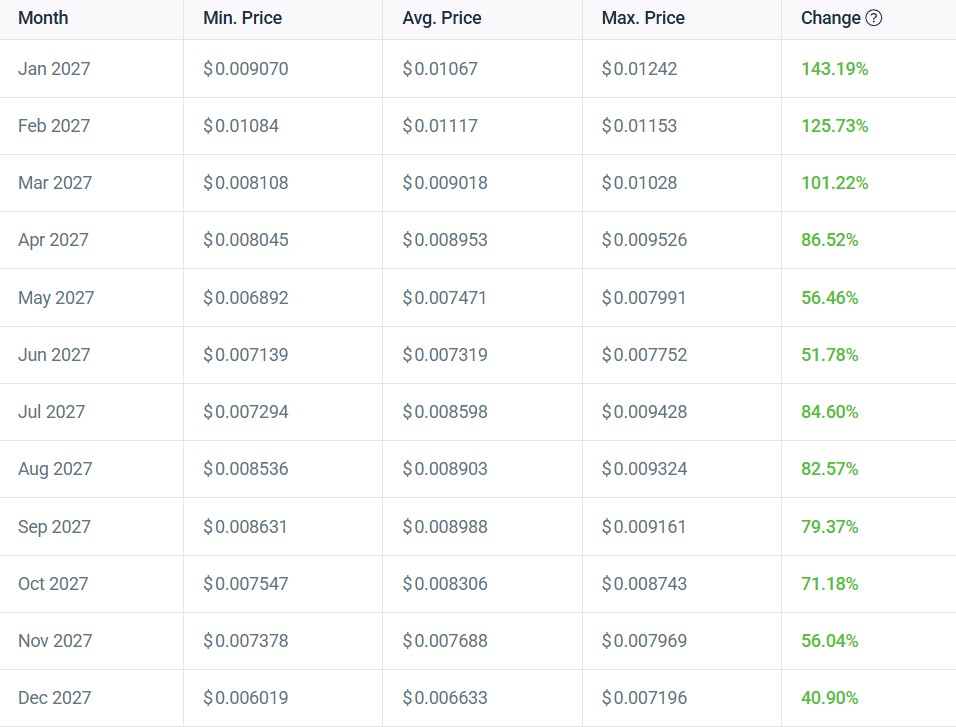
ALT: Onyxcoin (XCN) 2027 monthly price forecast table
Onyxcoin Price Prediction for 2030
Onyxcoin is expected to trade between $0.0081 and $0.0217. Beginning near $0.0090 in January, projected averages gradually move higher, with mid-year strength pushing prices toward $0.015–$0.018. In stronger months, maximum projections extend above $0.02. A wider band reflects stronger sensitivity to capital participation. Sustained demand would be required to hold upper projections. By this stage, sustained network activity becomes a primary valuation driver. Governance activity and staking engagement must translate into steady token absorption. Without that, higher projections would likely struggle to hold. By December, projected averages cluster near $0.014–$0.015. Still, the monthly variation highlights that 2030 could involve wide price movement.
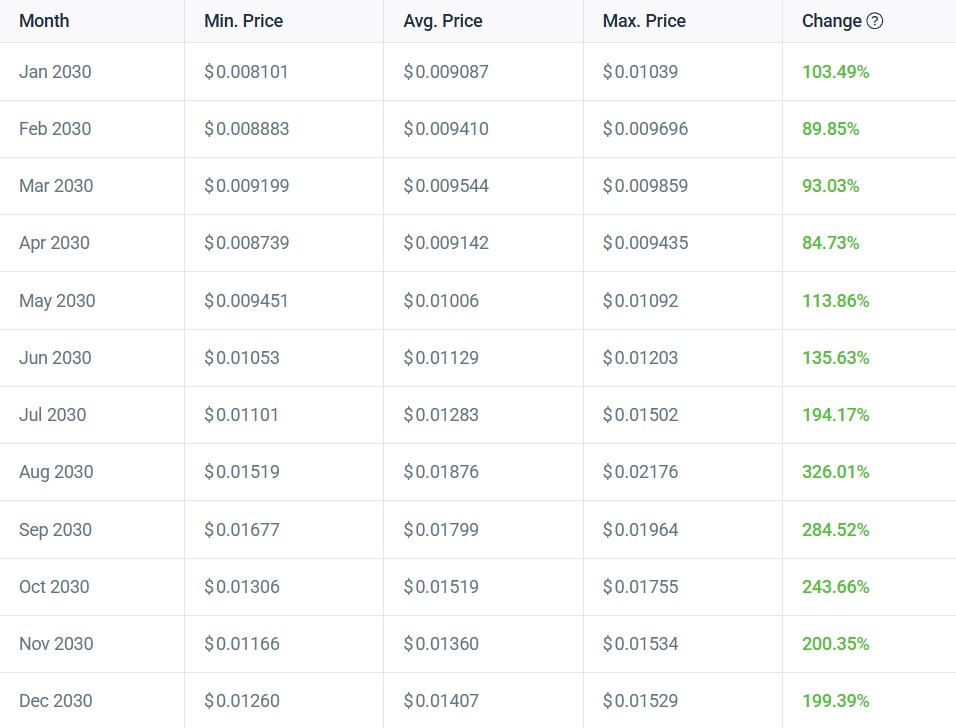
ALT: Onyxcoin (XCN) 2030 monthly price forecast table
Onyxcoin Price Prediction for 2040
XCN is expected to move between $0.019 and $0.036, with average values rising from about $0.020 in early 2040 toward the $0.032–$0.034 range by the end of the year. That projected increase reflects potential multi-year repricing, though outcomes remain conditional on sustained demand. In an adoption-driven scenario, sustained enterprise integration and consistent governance participation would absorb circulating supply over time. If network usage expands in measurable ways, projected highs near $0.03 and above become more defensible. Durable network demand would need to outweigh speculative flows.
A neutral survival scenario assumes steady but limited protocol engagement. In that case, price may hold within the $0.02–$0.03 range without meaningful acceleration. Capital allocation would remain cyclical and dependent on broader market conditions. Under competitive pressure, however, reduced relevance or declining participation could compress valuation toward lower projections. If alternative infrastructure attracts sustained activity, XCN may struggle to justify higher ranges.
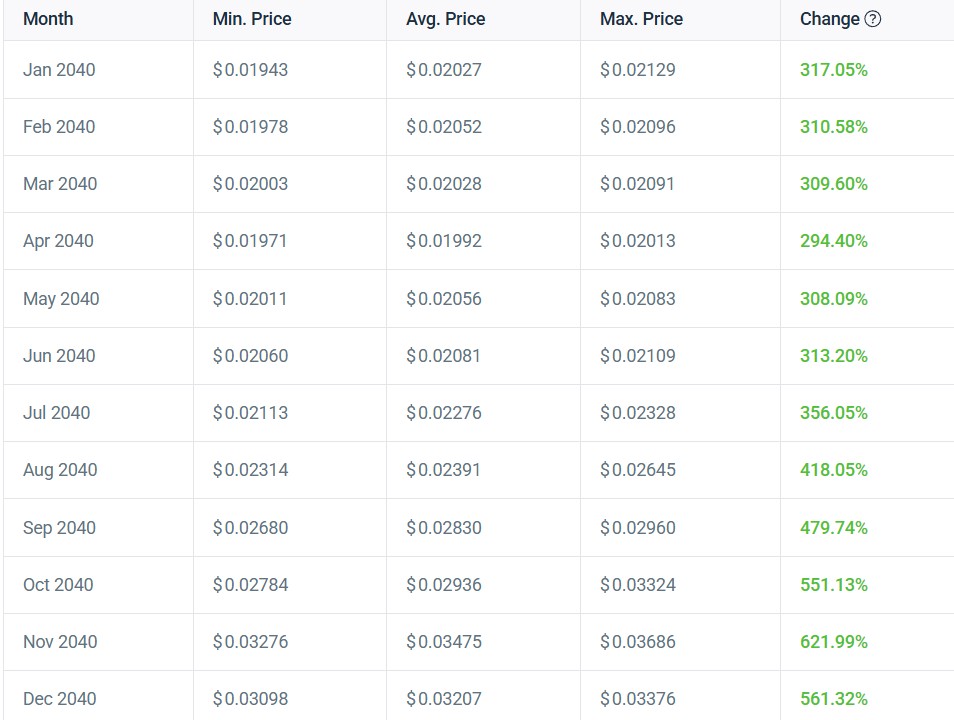
ALT: Onyxcoin (XCN) 2040 monthly price forecast table
Key Growth Drivers for Onyxcoin
Long-term valuation depends on consistent demand rather than short bursts of speculation.
- Enterprise blockchain integration
If Onyx Protocol secures measurable use within financial infrastructure or tokenization frameworks, token demand gains functional backing. Enterprise usage must translate into recurring network activity rather than one-off announcements. - Governance utility expansion
Broader governance participation increases the relevance of XCN within the ecosystem. When voting power and staking carry tangible influence over protocol direction, token holding gains practical weight. - Token supply management
With a large maximum supply, circulation control becomes central. Gradual distribution and responsible allocation reduce dilution risk and support price stability over time. - Exchange liquidity growth
Deeper exchange order books improve price discovery and reduce slippage. Stronger market depth allows capital to enter and exit without extreme price distortion. - Broader altcoin cycle participation
Mid-cap infrastructure tokens tend to benefit when capital rotates beyond majors. Sustained participation across that segment can lift valuation, provided internal fundamentals remain intact.
Risks That Could Limit Onyxcoin’s Growth
Upside projections remain conditional, and long-term risks deserve equal attention. The following factors outline where pressure could emerge:
- Market-wide liquidity contraction
If investors exit higher-risk assets, mid-cap tokens typically face outsized downside. Reduced trading depth can accelerate declines and limit recovery attempts. - Regulatory classification shifts
A change in token classification or compliance standards could restrict exchange access. That would directly affect participation and capital inflows. - Competition from Layer-1 ecosystems
If alternative infrastructure attracts developers and enterprise use, network relevance may weaken. Lower protocol activity reduces organic token demand. - Token unlock pressure
Large unlock events increase circulating supply. Without matching demand, added supply can compress price over time. - Developer inactivity
Slowing technical progress signals reduced long-term commitment. Inactive development weakens confidence in sustained protocol relevance
Is Onyxcoin (XCN) a Long-Term Investment?
Whether XCN fits a long-term strategy depends on your objective and risk profile. For traders, the token’s price structure offers periodic opportunities when capital rotates into mid-cap infrastructure assets. Those setups rely on timing and defined exit levels. For long-term holders, the case rests on sustained protocol relevance and measurable token demand. XCN carries a high volatility profile, as shown by its deep drawdown from prior peaks. That history matters because upward moves have previously been followed by deep retracements. So position sizing becomes critical. A disciplined allocation limits downside exposure while preserving upside optionality. Investors with lower risk tolerance may treat XCN as a satellite position rather than a core holding. In the end, long-term value depends on consistent network participation, not market enthusiasm alone.
Conclusion
Onyxcoin enters 2026 in a stabilization phase, with price reacting to defined support and resistance levels. From there, 2027 introduces wider price movement, where performance depends on sustained participation and market depth. By 2030, valuation reflects broader market conditions and the protocol’s ability to convert network usage into consistent token demand. And by 2040, the central question becomes survivability. Long-term upside requires measurable adoption and steady demand absorption. Without those drivers, projections remain conditional. XCN’s future ultimately depends on structural participation, disciplined supply management, and durable market engagement across cycles.
For more structured crypto market analysis, visit CoinWicks.
Frequently Asked Questions
1. How high can Onyxcoin go in 2026?
Based on current projections, 2026 upside appears capped near the mid-$0.005 range unless resistance is cleared with sustained volume. A move above that zone would require stronger capital participation and consistent order flow expansion.
2. Can Onyxcoin reach $1?
Reaching $1 would require a dramatic expansion in market capitalization and sustained structural demand. Given current supply levels, that scenario would require a multi-cycle repricing supported by significant network growth and capital depth.
3. What will Onyxcoin be worth in 2030?
Forecast models place 2030 estimates broadly between $0.008 and $0.021, with outcomes dependent on capital conditions and measurable protocol growth.
4. What affects XCN price the most?
Capital rotation into mid-cap infrastructure tokens has a strong influence on price behavior. In addition, supply distribution, exchange depth, and measurable protocol usage directly affect how valuation responds to market participation.