Pudgy Penguins (PENGU) became one of the most recognizable non-fungible token (NFT) collections during the 2021 market expansion. The decision to extend the brand into a tradable token altered its economic structure.
The token introduced direct pricing tied to expectations around brand execution. And expectations can expand quickly during strong cycles. They can also compress when liquidity tightens. The key question is whether token demand can grow alongside brand reach over time.
What Is Pudgy Penguins (PENGU)?
Pudgy Penguins operates today as a brand-centered ecosystem with a tradable token attached to its economic layer. PENGU serves as the tradable instrument through which the market prices brand execution and ecosystem participation.
The token launched in December 2024 with a fixed maximum supply of 88.88 billion, and roughly 70% was already circulating at launch. That structure limits future dilution risk but increases sensitivity to liquidity conditions. Market capitalization has reached the high hundreds of millions during stronger market periods.
Pudgy Penguins reflects expectations about whether brand expansion translates into sustained token demand in secondary markets.
Price History & Market Performance
Pudgy Penguins position today formed through successive market cycles that influenced both valuation and strategic direction.
Origins and Early Community Growth
Pudgy Penguins started as an NFT collection in July 2021 with 8,888 NFTs minted at 0.03 Ether (ETH). It sold out within minutes and quickly attracted more than 5,000 unique holders. Within a week, the floor price reached roughly 2.4 ETH, which reflected intense demand during the NFT expansion period.
A 400 ETH sale in 2022 reinforced premium positioning. At that point, valuation largely reflected the broader appetite for profile-picture collections.
Expansion Phase and Ecosystem Structuring
As NFT trading activity declined, the project focused on extending the brand beyond marketplace dynamics. Physical toys entered more than 3,000 major retail locations, with millions of units sold. Social engagement expanded into billions of content views across platforms.
The later introduction of PENGU placed the brand into continuous token pricing and wider crypto market participation.
Major Price Cycles and Market Reactions
Price continued to track broader crypto market conditions. During a mid-2025 sector rebound, overall NFT market capitalization surged, and Pudgy trading activity increased accordingly. Downturns also pressured Pudgy Penguins. At times, prices recorded double-digit percentage declines even during product launches.
Pudgy Penguins Price Prediction for 2026
The 2026 outlook suggests consolidation before any sustained expansion. Models referenced by platforms such as CoinCodex indicate moderate movement during the first half of the year, with stronger upside scenarios concentrated in the final quarter.
These are the projected monthly ranges.
| Month | Min. Price | Avg. Price | Max. Price | Change |
| Feb 2026 | $0.004912 | $0.005606 | $0.007017 | 2.69% |
| Mar 2026 | $0.005212 | $0.005487 | $0.005701 | -16.57% |
| Apr 2026 | $0.005250 | $0.005447 | $0.005695 | -16.65% |
| May 2026 | $0.004833 | $0.005141 | $0.005388 | -21.14% |
| Jun 2026 | $0.005109 | $0.005232 | $0.005344 | -21.79% |
| Jul 2026 | $0.005289 | $0.005493 | $0.005757 | -15.75% |
| Aug 2026 | $0.005554 | $0.005645 | $0.005738 | -16.03% |
| Sep 2026 | $0.005523 | $0.005794 | $0.006443 | -5.71% |
| Oct 2026 | $0.006354 | $0.007504 | $0.009803 | 43.47% |
| Nov 2026 | $0.01015 | $0.01545 | $0.01917 | 180.50% |
| Dec 2026 | $0.01190 | $0.01431 | $0.01634 | 139.09% |
From April through August, projected averages remain near the $0.005 range. That range implies limited conviction across the sector and restrained participation.
October projects a move above prior trading ranges. November and December carry the largest projected upside, but that expansion depends on renewed strength across the wider crypto market. Sustaining upper targets requires renewed demand across NFT-linked assets.
Technical and Market Sentiment Snapshot
Price trades within a defined range and has yet to establish a sustained direction. Attempts to move higher lose strength near resistance, while pullbacks slow as support approaches. That balance reflects hesitation.
Longer-term projections point to expansion later in the cycle. For now, price action has not confirmed that outlook.
Support Levels
- $0.0045 – lower boundary of the recent trading range
- $0.0050 – prior consolidation zone where downside pressure slowed
Resistance Levels
- $0.0075 – upper boundary tested during stronger sessions
- $0.0080 – near-term ceiling that must hold for sustained upside
In the near term, the price must establish acceptance above resistance before broader upside gains credibility. Over a multi-year horizon, upside depends on sustained demand across the NFT segment.
Pudgy Penguins Price Prediction 2027–2030
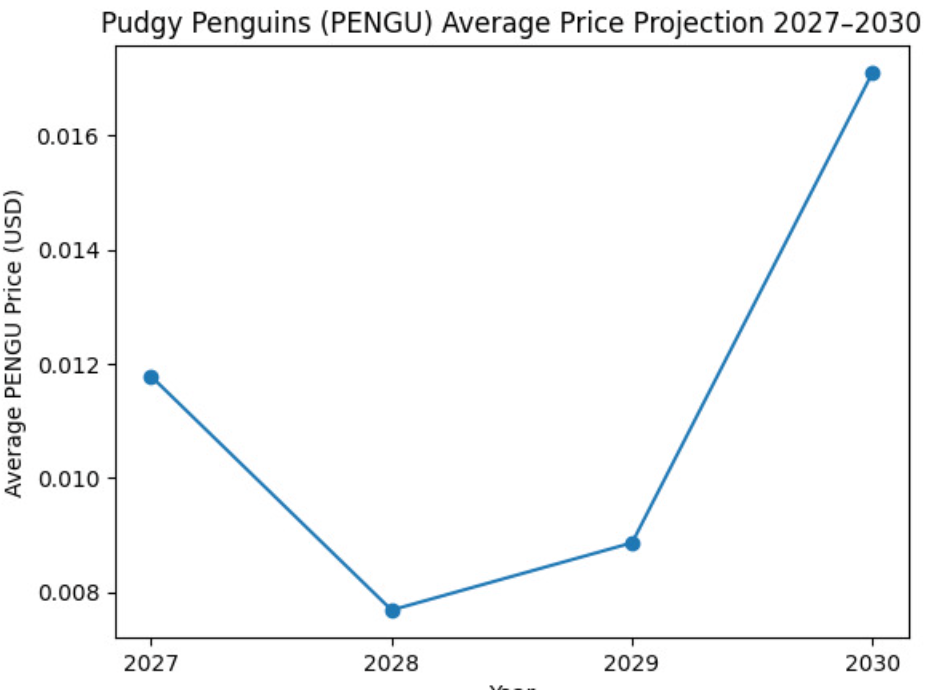
Long-term projections show changing price behavior between 2027 and 2030. Forecasts indicate strong positioning in 2027, a more contained range in 2028, gradual rebuilding in 2029, and broader expansion in 2030.
These are the projected yearly patterns based on the monthly ranges provided.
Pudgy Penguins Price Prediction for 2027
CoinCodex projections indicate that 2027 begins with elevated price levels. Average prices are expected to be near $0.014–$0.015 in January and February, with maximum values reaching approximately $0.0169 early in the year.
As the year progresses, the price settles into a narrower band. By December, minimum projections approach $0.0082, while average levels center near $0.009–$0.011.
This structure implies front-loaded strength. That kind of pattern typically occurs when prior cycle enthusiasm carries forward before participation stabilizes.
For PENGU, sustained levels above $0.012 would require measurable token demand tied to brand expansion. Without that, price rotates into a narrower valuation band.
Pudgy Penguins Price Prediction for 2028
In 2028, forecasts show activity concentrated within a defined corridor. Average prices move between $0.0070 and $0.0090, with minimum projections near $0.0066 and maximum levels approaching $0.0097.
This range reflects valuation compression after speculative repricing. For the token to break above this corridor, capital must treat PENGU as more than a cyclical NFT proxy.
That requires either increased exchange depth, visible ecosystem utility, or broader sector strength. Absent those factors, price remains anchored within structural support zones.
Pudgy Penguins Price Prediction for 2029
In 2029, projected averages could rise from $0.0071 early in the year to roughly $0.0101 by December. Maximum levels approach $0.0110.
This gradual lift suggests accumulation behavior. It implies capital rotation back into mid-cap speculative assets. If liquidity improves and NFT-linked assets regain relative strength, the price can migrate toward the upper band. If capital concentrates elsewhere, the rebuild remains gradual.
Pudgy Penguins Price Prediction for 2030
Projections expand significantly in 2030. Average prices move from $0.012–$0.013 early in the year to above $0.025 mid-cycle, with maximum estimates near $0.0295.
This widening band reflects higher sensitivity to macro participation. For PENGU to hold levels above $0.020, token demand must scale with brand visibility and exchange accessibility. Otherwise, volatility dominates the upper range.
| Year | Minimum | Average | Maximum | Phase |
| 2027 | $0.0082 | $0.010-$0.012 | $0.0169 | Early strength |
| 2028 | $0.0066 | $0.007-$0.009 | $0.0097 | Valuation compression |
| 2029 | $0.0068 | $0.008-$0.010 | $0.0110 | Rebuild |
| 2030 | $0.0111 | $0.013-$0.025 | $0.0295 | Speculative expansion |
Key Growth Drivers for Pudgy Penguins
Price development over time depends on specific factors that can support sustained demand. These are the core drivers that could influence how PENGU evolves:
- Brand monetization expansion
Steady income from merchandise and licensing shows that the brand can generate value beyond token trading. Price impact becomes more meaningful when those efforts increase user engagement that connects back to token activity. - NFT-to-token ecosystem utility
Clear token use within governance, access systems, or platform incentives can create recurring demand. When holders use PENGU for participation benefits, valuation reflects functional engagement alongside speculation. - Retail and IP partnerships
Wider retail distribution expands brand reach. The valuation effect becomes stronger if partnerships integrate token access or encourage wallet-based participation. - Broader NFT market recovery
Increased NFT trading activity typically supports assets linked to established collections. If capital returns to NFT segments, PENGU may benefit from renewed sector attention. - Exchange listings and liquidity growth
Broader exchange availability improves market depth and accessibility. Higher liquidity supports larger capital flows and smoother price discovery during active periods. - Crypto macro cycle resurgence
Stronger macro conditions tend to increase overall participation in digital assets. During such periods, brand-linked tokens usually attract greater speculative interest.
Risk Analysis: What Could Slow PENGU’s Growth?
Growth assumptions depend on favorable conditions.
These are the structural risks that could influence price behavior if they materialize:
- Market-wide volatility
Sharp changes in broader crypto conditions can alter participation quickly. When capital rotates away from mid-cap tokens, price compression tends to follow regardless of project-specific progress. - NFT market contraction
Pudgy Penguins remains linked to NFT sentiment. If trading activity across major collections weakens, relative demand for associated tokens may soften as well. - Token dilution or supply pressure
Large token unlocks or concentrated holdings can increase circulating supply. Higher sell-side availability may weigh on price if new demand does not match distribution. - Regulatory shifts
Changes in token classification or exchange compliance standards can affect accessibility. Reduced exchange access can narrow participation channels. - Competitive NFT brands
Emerging collections with token integrations compete for the same speculative capital. Capital concentration in newer narratives can redirect attention. - Execution risk in brand expansion
Retail partnerships and product launches must translate into measurable ecosystem activity. Limited token integration weakens the valuation link. - Liquidity concentration
If trading volume clusters across a few venues or wallets, price sensitivity increases during larger transactions.
Where to Track Pudgy Penguins Price and Market Data
Tracking price in isolation rarely provides enough context. Platforms such as CoinCodex offer live pricing, historical charts, and model-based forecasts that help frame possible scenarios over time.
These projections are not answers, but they provide structured reference points that make volatility easier to interpret. When projected ranges diverge from actual trading behavior, that gap usually signals changes in participation or sentiment.
Monitoring supply data and exchange activity across reputable aggregators adds clarity to liquidity conditions. Used consistently, these tools support more grounded analysis instead of reactive decision-making.
Conclusion
PENGU’s projected path from 2027 through 2030 reflects early strength, mid-cycle stabilization, gradual rebuilding, and wider expansion by 2030. Forecast ranges span roughly $0.0066 at the lower end in consolidation phases to near $0.0295 at projected highs.
Those bands highlight one constant: volatility remains embedded across all scenarios.
Price performance ultimately depends on whether brand expansion converts into sustained token demand. If participation scales alongside visibility, upper ranges become plausible. If engagement plateaus, valuation gravitates toward established support zones. Pudgy Penguins continues to function as a digital brand and token hybrid shaped by market cycles.
Frequently Asked Questions
1. How high will Pudgy Penguins go in 2026?
Projections for 2026 place upper estimates near the $0.019 range under strong sector conditions. Reaching that level would require renewed NFT participation and sustained token demand. If broader crypto participation remains moderate, the price is likely to remain within lower projected bands.
2. Is Pudgy Penguins a good long-term investment?
That depends on how one evaluates brand-linked tokens. PENGU’s value rests on whether brand expansion translates into durable token usage and liquidity depth. Investors who view it as a cycle-sensitive digital brand may approach it differently than those seeking purely infrastructure-based exposure.
3. Can Pudgy Penguins reach $1?
A $1 valuation would imply a market capitalization far beyond current projections. Achieving that level would require substantial supply absorption, major exchange integration, and sustained global participation. Based on existing forecasts, that scenario sits outside the modeled ranges.
4. What is the future of Pudgy Penguins?
Its trajectory depends on whether commercial brand growth reinforces token demand. If ecosystem activity expands alongside retail presence and exchange access, valuation can follow. If token usage remains peripheral to brand development, price behavior will track broader market cycles.
5. What factors could push Pudgy Penguins price higher?
Sustained NFT market recovery, deeper exchange liquidity, and measurable token utility could support higher price ranges. Broader macro expansion across digital assets typically increases capital allocation toward established brand-linked tokens.